Experience the northern lights in Canada
Once you've decided to take in the awe-inspiring splendor of the northern lights in Canada, all that's left to do is choose your ideal viewing experience and plan your trip. And with more ways to see the northern lights than anywhere else, Canada certainly has no shortage of options. From dogsledding and snowshoeing expeditions to cozy cabins, relaxing resorts, and traditional Teepee Villages, there's a northern lights experience for to suit every traveller's appetite for exploring.
Experience the northern lights in Canada
Once you've decided to take in the awe-inspiring splendor of the northern lights in Canada, all that's left to do is choose your ideal viewing experience and plan your trip. And with more ways to see the northern lights than anywhere else, Canada certainly has no shortage of options. From dogsledding and snowshoeing expeditions to cozy cabins, relaxing resorts, and traditional Teepee Villages, there's a northern lights experience for to suit every traveller's appetite for exploring.
Where to see the northern lights in Canada
Click on the map to discover all that the Yukon, Northwest Territories and Churchill, Manitoba have to offer and find the northern lights experience that's right for you.
Why Canada?
Auroral oval
The auroral oval is a ring-shaped zone around Earth’s magnetic poles where northern lights activity is most concentrated. Places such as the Northwest Territories, the Yukon and Churchill, Manitoba sit beneath this zone, giving them a front-row seat to the aurora.
Dark skies
The darker the sky, the easier it is to see the northern lights. Clear nights with little artificial light let the aurora stand out in all its color, which is why getting away from city lights can make for an even better view.
Long viewing season
Northern lights season lasts much longer than you might think. In the Yukon, viewing season runs from late August to early April, while the Northwest Territories has distinct fall and winter viewing seasons and up to 240 nights of aurora activity a year. In Churchill, the lights can be visible up to 300 nights a year, with January, February and March offering some of the best viewing conditions.
Why Canada?
Auroral oval
The auroral oval is a ring-shaped zone around Earth’s magnetic poles where northern lights activity is most concentrated. Places such as the Northwest Territories, the Yukon and Churchill, Manitoba sit beneath this zone, giving them a front-row seat to the aurora.
Dark skies
The darker the sky, the easier it is to see the northern lights. Clear nights with little artificial light let the aurora stand out in all its color, which is why getting away from city lights can make for an even better view.
Long viewing season
Northern lights season lasts much longer than you might think. In the Yukon, viewing season runs from late August to early April, while the Northwest Territories has distinct fall and winter viewing seasons and up to 240 nights of aurora activity a year. In Churchill, the lights can be visible up to 300 nights a year, with January, February and March offering some of the best viewing conditions.
Your month-by-month guide to northern lights viewing in Canada
Learn how, when, and where to best experience the aurora in Canada’s north.
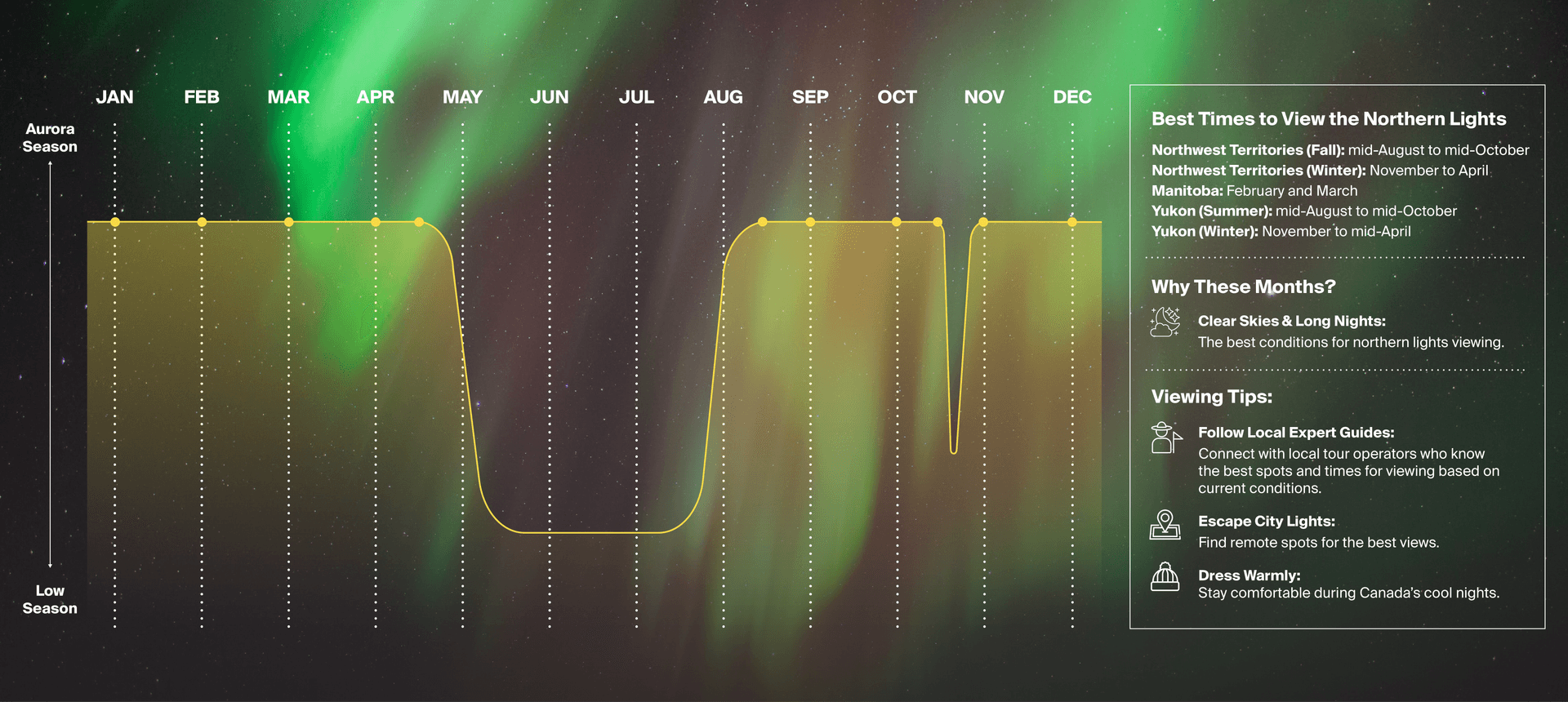
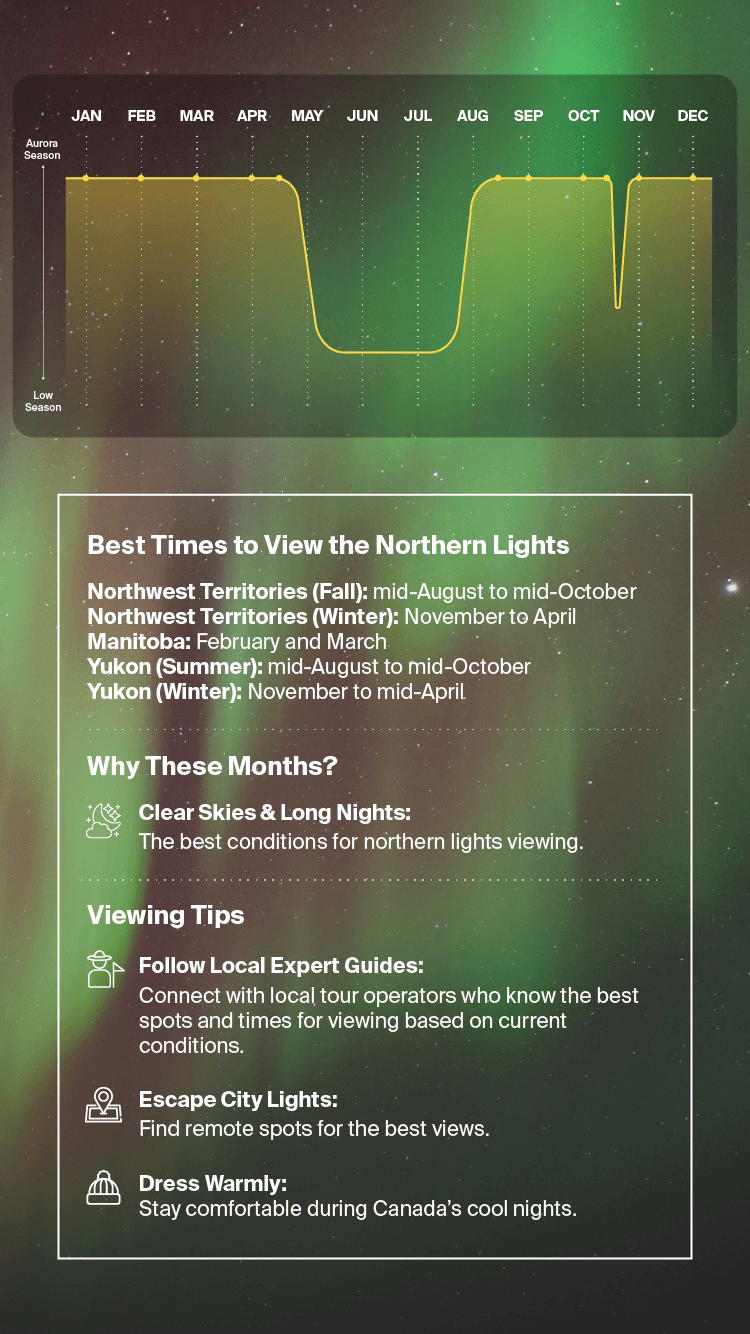
Your month-by-month guide to northern lights viewing in Canada
Learn how, when, and where to best experience the aurora in Canada’s north.
Best Times to View the Northern Lights
Northwest Territories (Fall): mid-August to mid-October
Northwest Territories (Winter): November to April
Manitoba: February and March
Yukon (Summer): mid-August to mid-October
Yukon (Winter): November to mid-April
Why These Months?
Clear Skies & Long Nights:
The best conditions for northern lights viewing.
Viewing Tips:
Follow Local Expert Guides:
Connect with local tour operators who know the best spots and times for viewing based on current conditions.
Escape City Lights:
Find remote spots for the best views.
Dress Warmly:
Stay comfortable during Canada’s cool nights.
FAQs: About the northern lights
It can be easy to get wrapped up in planning a trip to witness the northern lights, so here's some FAQ's to help make your trip easier.
The northern lights, or Aurora Borealis, are natural light displays in the Earth's sky, caused by solar particles interacting with the Earth's atmosphere. Oh, and they’re awesome.
The lights are most visible from late September to early April. Clear, dark skies without cloud cover offer the best conditions for viewing.
Pretty good—if you’re in the right place at the right time. The Northwest Territories, Churchill and the Yukon all offer excellent northern lights viewing opportunities. Churchill experiences aurora activity more than 300 nights a year, while the Northwest Territories can see it up to 240 nights a year. In the Yukon, the viewing season stretches from mid-August to mid-April, and staying for at least three nights can significantly improve your chances.
The northern lights can last anywhere from a few minutes to several hours, depending on the intensity of the auroral activity. The best time to see the northern lights is typically between 10:00 PM and 2:00 AM. We hope you’re happy, night owls.
Like any super proud parent, we could never choose a favorite. The Yukon, Northwest Territories, and Churchill, Manitoba all offer incredible viewing opportunities to see the northern lights.
The Solar Maximum occurs approximately every 11 years, when the sun is at its most active, creating more frequent and vibrant northern lights displays. While the current cycle peaked in late 2024, elevated solar activity is expected to continue for several years. That means you can still enjoy excellent aurora viewing opportunities without waiting for the next Solar Maximum around 2035.
Lights, camera, action
Gaze up at the truly life-changing experience of seeing the northern lights intricately dance across the night skies in the Northwest Territories, the Yukon and Churchill, Manitoba.
FAQs: Prepare for your northern lights trip
Northern Canada is accessible from major US hubs through connecting flights at some major Canadian airports including Vancouver International Airport (YVR) and Calgary International Airport (YYC) if you’re heading to the Yukon or the Northwest Territories. For flights into Churchill, connect through Winnipeg James Armstrong Richardson International Airport (YWG). Be sure to consult with your travel operator for the best possible route depending on your destination.
Pack warm clothing, including layers, gloves, hats, and insulated boots. Temperatures can be extremely cold, so it’s recommended to bring thermal layers and insulated outerwear. Can’t imagine how that’s all going to fit in your carry-on? No problem. You can always rent winter clothing from head to toe when you arrive.
Guided northern lights tours are available in all three destinations. To get started on finding your perfect package, check out these preferred packages or visit Fresh Tracks for more information.
There’s no shortage of things to see and do when you’re not marveling up at the northern lights. By day, you can revel in exhilarating snowmobile rides, mush with spirited huskies, explore the great outdoors on skis or snowshoes, explore Indigenous cultures and try delicious Northern delicacies.
If you’re looking for an experience that feels truly extraordinary, the northern lights are hard to beat. Imagine standing beneath a vast night sky as ribbons of color dance overhead, surrounded by Canada’s spectacular landscapes. With opportunities to see the aurora across different seasons and pair it with memorable local experiences, it’s an unforgettable way to experience Canada.
Still have questions?
We get it - it's a lot to be excited for! To find out more information or to explore each destination, visit their websites for even more travel inspiration: Northwest Territories, the Yukon, Churchill, Manitoba.